
The Organizations That Will Win With AI
This final article in the series reveals the six-part design system that determines whether AI strengthens human capability or quietly creates dependency.

THE AI CAPABILITY PLAYBOOK · ARTICLE 6 OF 6
Six articles. One question every organization is avoiding: Are you building capability or just building dependency?
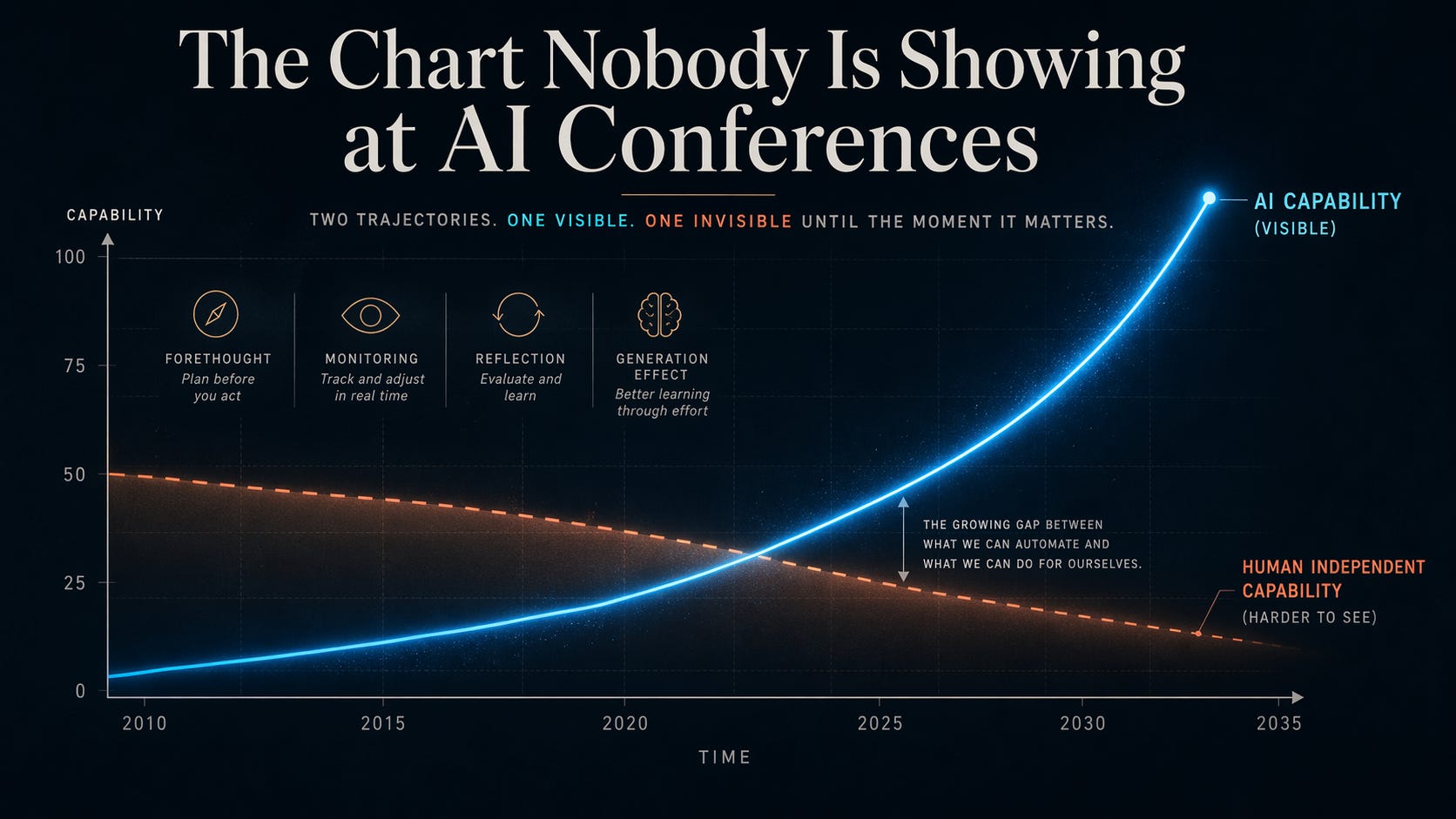
Two Organizations, Five Years From Now
Imagine two organizations, both operating in the same industry, both with broadly similar AI investments, both with broadly similar adoption metrics today.
At Organization A, investing in AI has significantly boosted speed and productivity. This has led to higher-quality outputs and better-informed decisions, creating real and sustained efficiency gains. Over the past five years, the organization has developed an impressive AI capability, complete with sophisticated tools, well-trained users, and optimized workflows.
While their people are better at using AI than they were five years ago, their underlying capabilities have not grown. When conditions change, a novel threat arises, a client requires judgment the AI wasn’t trained on, or a strategic turning point demands thinking no tool can generate, the organization is left with the same human skill it had five years ago, only now, it’s trapped within a more sophisticated dependency on the AI tools.
Similarly, Organization B’s investment in AI has enhanced the speed and productivity of its workforce. While the efficiency gains are on par, over five years, the organization has cultivated a more profound asset - deepened human capability. The professionals who use AI daily are not merely more productive; they have become better at their jobs. Their judgment has matured, their pattern recognition has sharpened, and their ability to navigate novel complexities has expanded. In this environment, the AI tools are valuable precisely because the humans using them are excellent, and both are continuously improving together.
Fast forward five years, and the two organizations are in vastly different positions. While Organization A has grown in one dimension, the other has quietly stagnated. In contrast, Organization B has achieved simultaneous, compounding growth across both dimensions.
The crucial distinction wasn’t the tools they used, their adoption rates, or their utilization metrics. Instead, it was the strategic decisions their leaders made about integrating those tools into the very fabric of how their people work, learn, and grow.
Every organization has the power to make these decisions, though most have not done so deliberately. This article explores what happens when they do.
What the Series Has Built To
Across five articles, a single, fundamental problem has been examined from multiple angles: organizations are deploying AI at scale but failing to invest in the human development required to unlock its long-term value.
In this series, we’ve explored the persistent gap between technology adoption and true business transformation.
Article 1 established the core issue: this isn’t a technology problem, but a human capability design problem.
Article 2 defined the leader’s role in deliberately shaping work to build, rather than erode, human capability.
Article 3 provided individual professionals with the key behavioral habits needed to secure their future relevance.
Article 4 offered organizations the metrics to identify the capability gap before it becomes critical.
Article 5 highlighted the team-level failure modes that are invisible to individual-level analysis.
This article builds the architecture that addresses all of them.
It’s not a theory but a design system, but rather a set of six elements that, when integrated into an organization’s AI strategy, can transform it from Organization A to Organization B within a five-year timeframe.
The Design System: Six Elements
Element One: The Capability Integration Audit
Before integrating AI into any significant workflow, it’s crucial to assess the human capabilities developed by the current process. This assessment should distinguish between two categories of skills:
Category 1: Skills that can be automated without any strategic loss.
Category 2: Skills that must be preserved because the expertise and judgment gained from performing them are a core competitive advantage.
If you outsource Category 2 work to AI, your team will gradually lose the ability to evaluate the quality of the AI’s output, becoming unable to differentiate between high-quality work and superficial results.
This audit should answer three questions for every significant AI integration decision:
What capability does this workflow currently develop in the humans doing it? Not what outputs it produces but what cognitive muscles it exercises, what judgment it builds, what expertise it develops through repetition.
Does that capability belong in Category 1 or Category 2? Using the three diagnostic questions from Article 3 of this series, can the output be fully specified in advance, does competitive advantage come from the result or from what is built in producing it, and would clients or stakeholders care whether a human or AI produced this?
If Category 2: how does the redesigned workflow preserve and develop that capability rather than substituting for it? What specific design choices ensure that AI integration sharpens human capability?
The AI audit is not a barrier to adoption, but a design practice that strengthens an organization rather than making it more fragile. By conducting an audit before integration, companies can avoid the common pitfall of discovering capability costs only after those capabilities have been lost, a pattern highlighted throughout this series.
Element Two: The Sharpening-First Workflow Design
Every significant AI-assisted workflow should be designed around the sharpening pattern rather than the replacement pattern as its default sequence.
The replacement pattern is where you encounter a problem, query AI, review output, and submit. It’s the path of least resistance. It is faster, easier, and produces good outputs in the short term. However, it also systematically bypasses the cognitive process that builds genuine expertise.
The sharpening pattern is where you first form your own analysis, use AI to challenge it, compare positions, update where it is earned, and submit. It requires more time and more discipline, but it also produces a professional whose capability compounds with every AI interaction rather than one whose capability migrates into the tool.
Designing for the sharpening pattern means making it the default sequence, not the exception. This involves three specific design decisions.
First, workflow design should build in a distinct step for “independent analysis” before making AI assistance available for any important work. While the AI is accessible, the default process should not be to use it first.
Second, we must foster a culture where professionals use AI not as a substitute for original thought, but as a partner for intellectual sparring. Instead of asking, “What is the best analysis of this situation?” one should propose, “Here is my analysis; what am I missing?” Although the tool remains the same, this simple shift in approach can have a profound developmental effect over time.
Third, professionals should engage in evaluation practices where they articulate the reasoning behind their AI-assisted work. This isn’t for auditing purposes, but rather a developmental exercise. It cultivates a deeper understanding that enables them to make AI output genuinely useful rather than just passively consuming it.
Element Three: The Deliberate Difficulty System
Robert Bjork’s research on desirable difficulties is unambiguous. The conditions that feel hardest in the moment produce the strongest capability over time. The conditions that feel easiest (smooth, immediate, frictionless) produce the weakest long-term retention and skill development.
AI-optimized workflows systematically remove friction, which is their immediate value. However, this convenience, if left unchecked, can become their long-term cost.
Designing for deliberate difficulty means building structured experiences where professionals regularly encounter the productive struggle that AI typically removes, not all the time, and not in ways that impair productivity, but deliberately and regularly enough that the capability muscles are exercised rather than atrophied.
In practice, this looks like three things built into how work is organized.
To maintain and assess your team’s core skills, hold regular “scaffold-removal sessions.” These monthly or quarterly meetings challenge teams to solve significant problems without defaulting to AI. The goal isn’t to test or punish, but to deliberately practice and keep underlying skills sharp. This also provides leaders with a clear view of their team’s true capabilities.
Assign stretch projects that challenge professionals to build upon the AI’s output, treating it as a starting point for independent development rather than a finished product for review. These tasks should push them just beyond their current comfort zone, encouraging them to reach for new skills rather than rely on existing ones.
Offer transfer practice, which deliberately exposes professionals to new problem structures. This requires them to apply their domain knowledge in unfamiliar contexts, a skill that Article 4 identifies as the clearest measure of genuine expertise versus sophisticated tool fluency.
Element Four: The Capability Feedback Loop
The metrics from Article 4 (the Capability Gap Index, Reasoning Depth Score, Transfer Performance Index, and Development Trajectory Score) should be integrated into the organization’s performance architecture, not as annual assessments but as ongoing feedback mechanisms.
The focus should be on development, not evaluation. If a professional’s Capability Gap Index is widening, meaning the performance gap between their AI-assisted and unassisted work is growing, it signals a need for a development conversation, not a performance review.
The question becomes: where is this dependency forming, and what specific practice can be implemented to address it?
When a team’s challenge rate declines, and its members begin confirming each other’s AI-assisted analyses rather than genuinely challenging them, it’s a clear signal that a conversation about workflow redesign is needed.
The question then becomes: which practice from Article 5 can restore the productive disagreement this team requires?
For a feedback loop to be effective, it must lead to action. This means managers need to be skilled in conducting developmental conversations, not just performance reviews. They must be able to distinguish between saying “your output is below standard” and “your performance is declining, so let’s build a plan together.”
Crucially, they also need the right development tools to address the issues the metrics reveal.
Element Five: The Learning Integration Model
The Outlearn Loop (NOTICE, BUILD, HARDWIRE, PERFORM) applied at the organizational scale is the connective tissue that holds the design system together.
At the organizational level, the first phase, NOTICE, involves creating a diagnostic infrastructure to reveal capability gaps. This is achieved through audits before making integration decisions, applying the metrics outlined in Article 4, and implementing the team-level diagnostics from Article 5. After all, you can’t design solutions for problems you can’t see.
The second phase, BUILD, at the organizational level means designing AI-integrated workflows around the sharpening pattern, ensuring that the cognitive work that builds genuine expertise is preserved within AI-assisted processes rather than bypassed by them. Independent analysis first. Challenge-based prompting. Explanation requirements for significant AI-assisted work.
To HARDWIRE at the organizational level means to embed structures that reinforce learning and turn it into a lasting capability. This includes integrating spaced-retrieval practice into development programs, adding reflection prompts to workflows, and establishing team-level practices from Article 5. These measures transform productive challenge from a social risk into a cultural norm.
At the organizational level, the final phase, PERFORM, involves removing the AI “scaffolding.” This means creating regular opportunities for professionals and teams to demonstrate their capabilities without AI assistance. This isn’t a test, but rather a diagnostic tool and a commitment to development. Performance without the scaffold reveals the truth: is the system genuinely building new capabilities, or merely borrowing them?
Element Six: The Leadership Operating System
Each of these elements requires leaders to ask different questions about the organizations they lead.
Not just “Are our people using AI effectively?” but “Is our use of AI making our people more capable, or more dependent?”
Not just “Are our outputs improving?” but “Are the people who produce those outputs improving?”
Not just “Are we getting more from our people with AI?” but “Are we building people who can get more from AI because they are growing more capable themselves?”
The leadership operating system isn’t a collection of new processes. Instead, it’s a framework of consistently asked new questions woven into work reviews, performance evaluations, development investments, and integration decisions.
By making it standard practice to ask, “What was your thinking before you used AI?” in every significant review, a leader installs a crucial element of this system. When posed consistently, this question transforms critical thinking from an individual discipline into a cultural expectation.
By separating discussions about output from those about development during feedback sessions, leaders can embed a continuous cycle of capability-building into their organization’s daily operations. This distinction illuminates crucial aspects of performance that output metrics alone often miss.
A leader who openly sharpens their thinking—reflecting before they question, using AI to challenge their reasoning rather than replace it, and engaging in the deliberate practice that hones keen judgment—builds the desired culture through their actions long before any policy is written.
The Decision This Series Has Been Building Toward
Across six articles, I have built a single argument. Now, allow me to state it plainly.
The organizations that will lead in the AI era will not be the ones with the highest adoption rates, the best tools, or the most sophisticated AI capabilities. They will be the ones where human capability and AI capability have grown together, where the people using the tools are genuinely better at their work because of how they use them, not just faster at producing outputs.
This outcome is not accidental. It is not the result of good intentions, the right tools, or even effective change management. Instead, it requires deliberate design and specific decisions about the structure of work, the integration of AI, the measurement of capability, team collaboration, and the nature of leadership.
Every element of that design is within reach for any organization. No part of it requires waiting for better AI, superior tools, or a more favorable market. What it does require is starting now, before the capability gap widens to the point where it can no longer be closed by development alone.
The question this series has been building toward is not a diagnosis. It is a decision.
Are you building capability or just building dependency?
The answer to that question is being determined right now. It’s woven into every AI integration your organization considers, every workflow that either fosters or forfeits the cognitive effort required for true expertise, and every leadership conversation that chooses to either probe deeper or settle for the surface-level solution.
Organizations that get this right will see human judgment and capability grow in tandem with AI-driven productivity. Those that don’t will face a widening gap between their AI systems and the human insight needed to unlock their true value.
This disparity is the capability crisis this series began with.
The design in this article is how you close that gap, before it closes options for you and your organization.
This concludes The AI Capability Playbook. If the series has given you a framework for building the organization that gets smarter rather than more dependent, share it with the leaders in your organization who are making the AI integration decisions that will determine which future you are building.
For the individual-level application of everything in this series, The Performance Playbook on this channel is the operational companion, which is the Outlearn Loop applied to your own professional development, phase by phase.
References
Bjork, R. A. (1994). Memory and metamemory considerations in the training of human beings. In J. Metcalfe & A. Shimamura (Eds.), Metacognition: Knowing about knowing (pp. 185–205). MIT Press.
Bjork, R. A., & Bjork, E. L. (1992). A new theory of disuse and an old theory of stimulus fluctuation. In A. Healy, S. Kosslyn, & R. Shiffrin (Eds.), From learning processes to cognitive processes: Essays in honor of William K. Estes (Vol. 2, pp. 35–67). Lawrence Erlbaum Associates.
Deci, E. L., & Ryan, R. M. (2000). The “what” and “why” of goal pursuits: Human needs and the self-determination of behavior. Psychological Inquiry, 11(4), 227–268. https://doi.org/10.1207/S15327965PLI1104_01
Gartner. (2025). CIO and technology executive survey. Gartner Research.
Gollwitzer, P. M. (1999). Implementation intentions: Strong effects of simple plans. American Psychologist, 54(7), 493–503. https://doi.org/10.1037/0003-066X.54.7.493
Hadwin, A. F., Järvelä, S., & Miller, M. (2011). Self-regulated, co-regulated, and socially shared regulation of learning. In B. J. Zimmerman & D. H. Schunk (Eds.), Handbook of self-regulation of learning and performance (pp. 65–84). Routledge.
McKinsey & Company. (2025). The state of AI: How organizations are rewiring to capture value. McKinsey Global Institute.
Slamecka, N. J., & Graf, P. (1978). The generation effect: Delineation of a phenomenon. Journal of Experimental Psychology: Human Learning and Memory, 4(6), 592–604. https://doi.org/10.1037/0278-7393.4.6.592
Sparrow, B., Liu, J., & Wegner, D. M. (2011). Google effects on memory: Cognitive consequences of having information at our fingertips. Science, 333(6043), 776–778. https://doi.org/10.1126/science.1207745
Stasser, G., & Titus, W. (1985). Pooling of unshared information in group decision making: Biased information sampling during discussion. Journal of Personality and Social Psychology, 48(6), 1467–1478. https://doi.org/10.1037/0022-3514.48.6.1467
Zimmerman, B. J. (2000). Attaining self-regulation: A social cognitive perspective. In M. Boekaerts, P. R. Pintrich, & M. Zeidner (Eds.), Handbook of self-regulation (pp. 13–40). Academic Press. https://doi.org/10.1016/B978-012109890-2/50031-7
Zimmerman, B. J. (2002). Becoming a self-regulated learner: An overview. Theory Into Practice, 41(2), 64–70. https://doi.org/10.1207/s15430421tip4102_2
Zimmerman, B. J., & Schunk, D. H. (Eds.). (2011). Handbook of self-regulation of learning and performance. Routledge.
Charles Good works with organizations that have already solved the adoption problem and are now asking the harder question. As President of the Institute for Management Studies, he reaches over 20,000 professionals annually. His Outlearn Loop framework, built on behavioral and learning science, is the architecture organizations use to design AI integration that builds human capability rather than substituting for it. He writes The AI Capability Playbook and The Performance Playbook on Substack and hosts The Good Leadership Podcast (Apple / Spotify / YouTube).